Thursday, October 7, 2010

Host Cities for 2011 Amgen Tour of California


Following weeks of speculation and anticipation, the Host Cities for the record-setting Amgen Tour of California professional cycling road race were announced this morning by race presenter AEG. Consistently considered cycling’s most important and successful road race held in the United States, the sixth annual event will cover more than 800 miles over the epic eight days.

The 2011 Amgen Tour of California will travel to and through 15 Host Cities throughout the state over the course of eight days from May 15-22, 2011. Last year’s date change from February to May allowed the Tour de France-style road race to visit locations that would not have been possible previously, including a visit to Big Bear Lake. Due to the incredible success, the race will remain in May to provide fans with the most action-packed, exciting race possible.

The race will wind through miles of beautiful California terrain, beginning with the first-ever visit to Lake Tahoe, a well known cycling destination and home of “America’s Most Beautiful Bike Ride.” The eight-day race will travel through some of the state’s most scenic landmarks, with the overall finish taking place in title-sponsor Amgen’s hometown community of Thousand Oaks.

The 15 official stage start and finish communities that have been selected for the 2011 race include: South Lake Tahoe (new for 2011), North Lake Tahoe-Northstar at Tahoe Resort (new for 2011), North Lake Tahoe-Squaw Valley USA (new for 2011), Sacramento, Auburn (new for 2011), Modesto, Livermore (new for 2011), San Jose, Seaside, Paso Robles, Solvang, Claremont (new for 2011), Mt. Baldy (new for 2011), Santa Clarita and Thousand Oaks.

“Last year we witnessed the benefits of moving the Amgen Tour of California to May – better weather, a new, challenging route and more intense competition,” said Andrew Messick, president of AEG Sports. “In 2011 we plan to continue to showcase the beautiful features the state of California has to offer, while also continuing to raise the bar for what it means to be the largest, most important cycling race in America.”

Highlights of the 2011 route include the race’s first visit to Lake Tahoe, with the first day of racing featuring a more than a lap and a half around the lake. The riders also will summit famous Donner Pass on the way to Sacramento. On the way to San Jose, America’s largest cycling event will venture into the Diablo Mountains for the first of two challenging mountain stages for the world-class cyclists. The riders will once again take the beautiful Pacific Coast Highway down the coast through Big Sur. Another exciting addition to the 2011 race is the final climb up to the Mt. Baldy ski area, whose steepness and switchbacks are legendary in the Southern California cycling community.

“The 2011 Amgen Tour of California route is going to result in an exciting and compelling race,” said Lance Armstrong of Team Radioshack. “All of us at Team Radioshack are looking forward to it.”

Beginning with the inaugural year in 2006, the Amgen Tour of Californiaquickly became the most successful race in the United States with regards to economic benefits to the state, global recognition and the level of competition. The race also continues to set records in attendance for a single sporting event in the state of California, as well as any cycling event ever held on U.S. soil, with more than 2 million spectators in previous years.

“From the world-class riders and challenging competition, to the tremendous amount of support from the fans and Host Cities, the Amgen Tour of California has grown to become one of the most anticipated events within the international cycling community,” continued Messick. “Making the final selection of Host Cities for the race becomes an increasingly challenging task each year.”

With the 2011 Amgen Tour of California once again taking place in May, the cyclists will have more time to train, and the competition promises to be even tougher. In previous years, the race has drawn some of the world's most renowned and respected riders, such as top Tour de France competitors, World Champions and Olympic medalists that include Lance Armstrong, Tom Boonen, Oscar Freire, Paolo Bettini, Fabian Cancellara, Carlos Sastre, Ivan Basso, George Hincapie, Mark Cavendish and Andy Schleck.

“I was in as good of shape the past three years [when I won the Amgen Tour of California] as I am now,” said Levi Leipheimer, race winner from 2007-2009, after the 2010 race. “The difference this year is that you see a couple of riders on the same level. The competition has definitely risen.”

“For our team, there’s only one race more important to us than the Amgen Tour of California, and that’s the Tour de France. This is a huge result for us. We can really walk away from the 2010 Amgen Tour of California with big smiles on our faces,” said Australian Michael Rogers of Team HTC-Columbia after winning the 2010 race.

Returning as the title sponsor for the sixth consecutive year, Amgen will continue to leverage the race to raise awareness and support for people affected by cancer through its Breakaway from Cancer® initiative. A leading global biotechnology company with headquarters in Thousand Oaks, Calif., one of the 2011 race Host Cities, Amgen's invaluable support has helped to ensure the continued success of the race and impact beyond the sporting arena.

“The 2011 Amgen Tour of California route will deliver new challenges for the professional cyclists and also give Amgen an opportunity to introduce our company and our Breakaway from Cancer initiative® to California communities that are getting involved in the race for the first time,” said Stuart Arbuckle, vice president and general manager, Amgen Oncology. “We look forward to collaborating with all of this year’s Host Cities to spread awareness about Amgen, our mission to serve patients through using biotechnology to create medicines for people with grievous illness, and the incredible support services that are available free of charge to people affected by cancer through Amgen’s non-profit Breakaway from Cancer® partner organizations.”

The only American race listed on the international professional cycling calendar with a 2. HC ranking, the Amgen Tour of California has drawn the attention of both cycling enthusiasts and first-time spectators, solidifying its position as one of the most anticipated cycling events of the year.

The 2011 Amgen Tour of California will visit 15 Host Cities for official stage starts and finishes, while other cities along the route also will have the opportunity to witness the excitement of elite professional cycling. Stages for the 2011 Amgen Tour of California include:

* South Lake Tahoe to North Lake Tahoe-Northstar at Tahoe Resort
* Stage 2: Monday, May 16 – North Lake Tahoe-Squaw Valley USA to Sacramento
* Stage 3: Tuesday, May 17 – Auburn to Modesto
* Stage 4: Wednesday, May 18 – Livermore to San Jose
* Stage 5: Thursday, May 19 – Seaside to Paso Robles
* Stage 6: Friday, May 20 – Solvang Individual Time Trial
* Stage 7: Saturday, May 21 – Claremont to Mt. Baldy
* Stage 8: Sunday, May 22 – Santa Clarita to Thousand Oaks

Wednesday, October 6, 2010

Chris Lieto's 2010 Ironman Hawaii Trek Bikes


One man synonymous with fast riding in Kona is US athlete Chris Lieto. Last year Chris reached T2 with a margin of 12 minutes over his chasers, and only defending champion Craig Alexander was able to catch the hard-riding American on the marathon. Last year Chris was riding a prototype version of the now released-to-market Trek Speed Concept triathlon bike, and this year once again will be on the latest and greatest that Trek can provide to the man who once again is expected to be leading the field on the Queen K Highway.

A Day In The Life For Lance Armstrong


Lance Armstrong started his day off in Aspen with a one hour run and then hit the local bakery for some coffee and NONE Primal treats before boarding his private jet. He then took off to Atlanta to be the guest speaker at the NACS show. After speaking at the show he took off for home, but this time in Austin. All a days work for Lance!

Motor Pacing On The Queen K With Macca & T


Macca and Terenzo Bozzone motor pacing on the Queen K.

Endurance Conspiracy Talks With Tim DeBoom One Week Out From Kona 2010


Endurance Conspiracy founder, Tony DeBoom, chats with brother Tim on the Big Island of Hawaii about one week out from the Hawaiian Ironman.


Tim shows off the uniform he will be wearing at the 2010 Hawaiian Ironman World Championships. Not many things appear to tower over the great Mount Fuji, but the Great Wave of Kanagawa appears to do just that in this famous painting by Hokusai. Pearl Izumi once again sets the standard.

Tuesday, October 5, 2010

Katya Meyers Talks About Ironman

Lance Armstrong blood and urine samples could be subject to new anti-doping test


Tour de France champion Alberto Contador could very well wiggle free from a brand new anti-doping test that detected metabolites of plastic in his urine, a sign he may have received banned blood transfusions.

But the fact that the test exists probably spells even bigger trouble for Contador's rival and predecessor on the top step of the Tour de France podium, Lance Armstrong, who is the subject of a federal grand jury investigation into doping conspiracies on his teams.

Armstrong has left blood and urine samples in laboratories all around the world, often announcing the tests in his Twitter feed. Many of those specimens are in storage, where they are fair game not only to anti-doping agencies but to the federal law enforcement agents who have zealously pursued Armstrong since May, when his former teammate, Floyd Landis, accused Armstrong of organizing systematic doping on the U.S. Postal Service cycling team.

Armstrong has strenuously denied Landis' claims that he and his teammates won races by reinfusing their own blood. The method is thought to have gained popularity in cycling since 2000, when anti-doping authorities developed a urine test for the endurance-boosting anemia drug erythropoetin, or EPO.

Which man is lying, Landis or Armstrong, is a mystery that could be settled by the new test, which detects traces of plastics from blood bags. Anti-doping experts say the test could work on preserved samples.

"Nothing that I've seen suggests that (the metabolites) would break down during frozen storage," said an anti-doping expert familiar with the new test. "I can't see any reason why they would break down. They're not a biological molecule, like EPO or testosterone, they're a completely stable, synthetic molecule."

The federal grand jurors investigating Armstrong would need only a subpoena to apply the new test to the cyclist's old urine; the U.S. Anti-Doping Agency has tested Armstrong at least 15 times in the last three years. To get samples overseas, prosecutors would merely have to file paperwork known as "letters rogatory," according to former federal prosecutor Bradley Simon.

"We have no concerns at all about it," said Armstrong's spokesperson Mark Fabiani.

The new test, which was developed in some secrecy over the past two years, measures three different metabolites of di-(2-ethylhexyl)phthalate, or DHEP, a chemical that leaches out of plastic containers into the fluids they contain.

In recent months, the test was performed on samples provided by Contador, and scientists found a sudden spike in the metabolites, a person familiar with Contador's case told the Daily News.

"There's enough samples to show a clear pattern," the person told the News. "They increased and they decreased afterwards in a way that you would expect if a transfusion occurred. . . . It's nothing like the levels that you would get from day-to-day exposure."

Because the plasticizer test is not yet validated by the World Anti-Doping Agency, there is not an official threshold set for how much of the metabolites are allowed in an athlete's system. According to the person familiar with Contador's case, his tests revealed fluctuating levels, and more than could be explained away by heavy exposure to water bottles or other plastic products.

The presence of plasticizers in Contador's samples was first reported last week by Hajo Seppelt of German broadcaster ARD and Damien Ressiot of the French sports daily L'Equipe. Tuesday, The New York Times reported Contador's suspicious plasticizer readings came in a sample submitted July 20, a day before Contador tested positive for the banned substance Clenbuterol.

Contador, a three-time winner of the Tour de France, has denied using performance-enhancing drugs and methods, and has blamed the Clenbuterol test on contaminated meat. Unless he can successfully challenge the evidence, he's facing a two-year ban for the Clenbuterol test, and the plasticizer readings could complicate his legal strategy.

The test for plasticizers was developed by a group of anti-doping scientists in Spain, Germany and Australia. The test was publicized at a conference in Tokyo in November of 2009, when a group of scientists representing the World Anti-Doping Agency's accredited laboratories were told that an exciting new test was coming down the scientific pipeline.

When some of the scientists developing the test published a report on their findings in the January 2010 edition of the journal Transfusion, some people in the anti-doping world were upset, thinking the labs would lose the element of surprise. (Intravenous infusions have been banned by WADA only since 2005, so the presence of plasticizers in samples older than that would be legal from an anti-doping perspective.)

"We fully intended to have this test up and running before publicizing it," said the person familiar with Contador's case. "We had feared that once that article was published, athletes would start finding work-arounds."

There is a vast amount of research out in the world about DHEP and other compounds that leach out of plastic containers and into the food and medicine people consume on a daily basis. Much of the research is driven by concerns that the plasticizers might be carcinogenic or cause birth defects.

The federal probe into Armstrong is based in the U.S. District Court in Los Angeles. The agent driving it is BALCO-busting Food and Drug Administration investigator Jeff Novitzky, who has worked closely with anti-doping agencies in the past.

Armstrong and his defenders have pointed to Landis' own admissions that he had no evidence of the cheating he claims to have witnessed and participated in.

But the new plasticizer test might mean that Landis, Armstrong and other cyclists have been building an evidence list all along, one beaker at a time, in refrigerators all around the world.

Jon Blais - The Blazeman

Ironman Hawaii "I Can" - Are You Ready?

Macca's 2009 Ironman Journey


A different view of the journey of Macca in one of his most memorable races in Kona. Not the win we are used to seeing from Macca but in his own words, 'A tough and inspiring day of personal accomplishment and growth."

Macca: Experience -The signs of OverTraining


By Chris McCormack

How do you interpret a fall in performance during training? Your criteria for to little training, the criteria for too much.

Very much by feel. Fatigue is something you know you are suffering and over the years I have been able to become very honest with myself and know when I am being just plane lazy or when my body is screaming out for rest. I think this honestly has been the primary reason for my longevity in career. By knowing what your body needs and then understanding how it responds, you get to, slowly over time, get a feel for your body rhythms and determine when you are starting to push the envelop too much. This becomes critical as you age as your body does not recover as quickly as it did when it were younger. Being confident enough to let it go and say, that is enough for today, and then not question that decision is the key. Guilt is what can hurt you more if you can’t learn to have this ability to say enough is enough when your training.

So giving you an exact criteria s difficult. I guess the signs are pretty obvious when you have done too much. Heavy legs, body aches and sleep issues, lost appetite etc, but this being said just because you suffer anyone of these symptoms doesn’t mean you immediately call off the training. Training is about testing your body, allowing it to recover and then doing it again. It is a fine line we walk and for this reason your own body awareness is key. You can suffer any one of these symptoms and continue to train hard and many times I do. It is just being aware when enough is enough and for me it is totally a feel. My body then does not want to respond to sessions and I am super fatigued.

What does the feeling of heavy legs mean to you? Do you change anything in your actual training?

It means many things. It means I have done a lot of work, it means I am on track and it can also mean that I may need to rest. It is a very broad comment this, heavy legs because as a triathlete you can have heavy legs for many reasons. I usually assess just how fatigued and heavy the legs are and if it is for a prolonged period of time I start to really reduce my workload and pile on the recovery. Your training volumes are reduced and more so the intensity of your workloads are reduced. I begin to focus on more active recovery workloads until I feel that the body is returning to a level where we can work out hard again. Now a period of heavy legs if it lasts more than 5 days, then you start to make this dramatic adjustments. If it is only lasting for 1 or two days then this can often be considered as normal for the type of workloads we are enduring. Ironman and endurance athletes are pushing the envelop of training all the time, and the difference between the good athletes and the great athletes is this body awareness I believe. Being able to make calls on just when you have done too much and then make the adjustments to rectify the issue so you can continue to push on.

When was the last time you experienced heavy legs or a drop in performance despite a good training blog?

It has been a while primarily because I tend to err on the side of cautious training as I have moved into my late 30’s. I am a much more confident athlete now when it comes to training plans and volumes and just what needs to be done and what I can handle. I always err on the side of less now primarily because I have noticed that my recovery is a lot slower than it was when i was in my 20’s. You need to be confident enough to be able to let go of your set training parameters that you have drawn up from years of training and realize that you can’t always replicate exactly what you did when you were 25. You can still do it, you just need to make sure that the workloads either side of your big sessions are adjusted so you can absorb that work. I think for this reason I have been able to really control my performances and remain injury free which is key. The last time I think I honestly blew my training and completely overtrained was in 2003 preparing for the Ironman. I got married in August and left myself very little room for preparation for the race. I really pushed the envelop of training and did some incredible workloads. I then when I came time to taper my body was simply cooked and the drop in volume just shut my body down. I was totally destroyed that year. I did 12 weeks training in 7 weeks. I look back now and shake my head but I can see how people get caught up in a system of too much and not pay attention to the signs. It is fear and panic that pushes people here and you fail to look around and slow down and assess when you are driven by these two emotions.

What was your initial thought – did you recognize it as overtraining right away?

No, I did not realize it was overtraining until it was too late. I think you have this perception that you are doing a lot, but as Endurance athletes we border crazy training volumes anyway, so putting a point on what is too much or not enough is the hardest thing. I think I knew I had cooked myself when halfway through my taper all I wanted to do was sleep. My body was not responding to the rest and I was not bouncing back and starting to feel fresher, I was actually really starting to feel worse. It is normal to feel a little lethargic in a taper but after 5 or 7 days this starts to go away and your body really starts to feel healthy and pumped again. In 2003 I never had this feeling at all. I started to feel better sure, but my desire to sleep was huge, my appetite really never returned which was strange and an immediate indicator for me that things were not right. It was too much to quickly and the body being resilient will try and hold together but when it breaks it breaks hard and it is too late.

How much recovery time did it take you to come back and how did you spend it (easy running, swimming, entirely off training?)

It did my season. I took off after Kona until early december and did nothing. I really tried to give my body a solid rest. I always worry about the heart muscle and try to give the heart a break from those high intensive workloads that we put it under when we are training hard. The heart can fatigue I am sure of it, and I always really focus on end of season on giving my heart a rest from those types of exercise that elevate it too much. I try to do yoga and softer stuff like surfing just to keep the body in good shape but give my heart a break. In 2003 I gave my body a solid rest and didn’t start to get into any structured workloads until the new year. From mid October until December 31. Thats a big break and my body was happy for it.

Did you feel any difference in performance after allowing sufficient recovery?

Of course, coming back from prolonged periods of rest is always difficult because building your fitness base again is tough. When I rest I seriously rest properly. I don’t do much aerobic work at all, so I take my time into building my fitness. I was doing an Ironman in early April and dominated this event so I guess I can say that the recovery was great for my body and the comeback after this was very solid. I had a very impressive year in 2004, so things went well post this 2003 training mistake.

How and what nutrition to you use to support recovery in such a case?

I am naturally an 85kg man. My body tends to move very quickly to this weight when I have a break. I race at 77kg which is as light as I can get without breaking down. I honestly think the body does not like to run this light for long periods of time and giving your body a chance to sit at this proper weight for a period of the year is important. When I take a break I try to let my body gravitate back to its natural weight, but I eat very well so it is my natural weight. I am not caught up in this weight focus that I have to be as a larger athlete racing these endurance events. Sport Scientists told me I was too big to ever race Ironman events. I was a power athlete and the Ironman races were built for the smaller athlete. Well, now I have won more Ironman races than any other male and won the World Championships when they said it would never be possible. I did this through closely watching my nutrition during a season and understanding my body’s weight limitations when it comes to training workloads and strength. As for supplements the key for me is supporting my immune system to allow me to do the volumes I require and slowly bring my weight down without getting sick. The only product I use is Biestmilch and that is the truth. The rest of the time I eat very well, I enjoy a very Mediterranean palate and extra spicy foods especially chillies. When ever I am looking at recovery I am focused on eating well, hydrating well and balancing my diet.

Essence of Ironman Hawaii

Cipollini critical of Italian Worlds tactics


Mario Cipollini has led criticism of the Italian team’s performance in Sunday’s world championships road race and questioned Filippo Pozzato’s credentials to lead the team. He also reiterated his belief that manager Paolo Bettini should have brought a sprinter to Australia.

Cipollini was perplexed by the Italian tactics and wondered whether it was in Pozzato’s best interests for his teammates to ride on the front and make the race difficult.

“I wouldn’t have started making the race hard from so far out, because the route didn’t allow it and because Pozzato was leader,” Cipollini told Gazzetta dello Sport. “What tough races has Pippo won in the last four years? And if he had cramps in the finale, as I read, who was Bruseghin riding for on the last lap?

“This isn’t a personal criticism of Pozzato, but I repeat, let’s look at what he has won in the last four years.”

The 2002 world champion was one of a number of former Italian rainbow jersey winners who offered their analysis of the race to Gazzetta dello Sport after the dust settled on the squadra azzurra’s Australian campaign.

Opinion on Pozzato’s performance among the former champions was divided. For Gianni Bugno, Pozzato “did what he could” while Francesco Moser felt that “he could have done better.”

Meanwhile, both Felice Gimondi and Giuseppe Saronni believed that Pozzato should have followed Philippe Gilbert (Omega Pharma-Lotto) when he attacked on the last lap. “Pozzato said that Gilbert was the favourite,” Saronni said. “Therefore he should have gone with him. I think they could have gone to the finish together and decided the title between them.”

The thorny issue of whether the Italian line-up should have included a sprinter continues to fester. Cipollini had been vocal in his criticism of Bettini’s exclusion of Daniele Bennati (Liquigas-Doimo) from the party that travelled to Geelong and he felt vindicated by the outcome of Sunday’s race, won by Thor Hushovd (CervĂ©lo) in the sprint.

“I would even have brought both Bennati and Alessandro Petacchi,” Cipollini explained. “Is it such an absurd scenario to imagine, for instance, Bennati leading out the sprint and Petacchi winning the Worlds? The podium speaks for itself.”

Felice Gimondi also felt that Petacchi was the the man to beat Thor Hushovd in the finishing straight, while both Saronni and Moser felt that Bennati could have had his say.

Bugno, however, felt that Hushovd’s victory was proof that the course was too tough for the pure sprinters. “Hushovd isn’t a sprinter like Cavendish or Farrar, he’s a rider who’s come close to winning a classic like Paris-Roubaix,” Bugno told Gazzetta. “Having a sprinter would have meant risking having a man less in the finale.”

Indeed, of the five former champions canvassed by Gazzetta, Bugno was by far the least critical of the Italians’ race, praising Bettini’s tactics. However, Francesco Moser felt that when the race broke up with two laps to go, the five Italians who made the split should have pressed on the make sure the sprinters didn’t get back on: “That was they error. They needed to have belief.”

Moser’s eternal rival Saronni disagreed with that assessment, feeling that if anything, the Italians had done too much work on the front. “If Pozzato had cramps, I’d wonder if making the race so hard didn’t harm him in the end,” Saronni said. “Do the riders talk to each other during the race?”

In the build-up to the race Paolo Bettini pinned an interview Cipollini gave on the wall of Marzio Brusegin's room as a motivational tool, and if the initial reaction to Sunday's race is anything to go by, the double world champion may well have a stockpile of such material to employ ahead of next year's race in Copenhagen.

Monday, October 4, 2010

Mario Cipollini's New Bike - MCipollini


Join Matt Dixon for the daily "Coach's Update" during the Countdown to Kona - October 9th, 2010


Each day from now through the start of the Ford Ironman World Championship race, Matt will provide thought provoking insight and commentary about the purplepatch athletes being sent to the event. He'll give you a brief summary of their background, challenges, training approach, adjustments and predictions at Kona! Stay tuned and come back each day for another athlete feature.

Click on the title link to hear Matt's view...

Pop Musician Howie Day to Perform at 1st Annual Kona Concert Series during Ironman Week


Race week during the Ironman World Championships in Kona bustles with activity of nervous athletes, triathlon brands showcasing their hottest products and traditional pre-race meetings and logistics. This year, famed solo ‘pop’ artist Howie Day will break up the customary week activities by performing at the 1st Annual GU Kona Concert Series, hosted by the Sheraton Keauhou Bay Resort & Spa along with a group of leading industry triathlon companies. The event will be held Wednesday, Oct 6, from 6-9pm at the Sheraton Keauhou Bay’s private, outdoor Hawaii Lawn overlooking the Pacific Ocean.

Mitch Thrower, Co-Founder of Active.com and former Co-Owner of Triathlete Magazine, will emcee the evening at which many pro athletes will also be in attendance, in particular two-time Ironman World Champion, Craig Alexander, who has traditionally called the Sheraton ‘home’ for him and his sponsors.

“I am hoping that the Kona Concert Series becomes an annual event, providing a unique and fun atmosphere for Ironman attendees, competitors, and industry leaders – BUT we also realize that it’s race week and we respect the need for the competitors to get to sleep at a reasonable time, thus the music will only go until 9pm,” said Franko Vatterott, of the Human Interest Group and one of the event organizers.

While the concert is billed as a free event, the organizers request that tickets are reserved in advance. Tickets are available through a select group of industry companies and media sources: GU, Tri Grand Prix, Saucony TYR, Scott Bikes, Athlete’s Honey Milk, TriSports.com and BUMP.com.

There are still tickets available. You can contact the GU Kona Concert Series partners via their on-island locations.

GU:
The booth out front 78-6622 Alii Drive

Saucony:

Tri Grand Prix:

TYR:
TYR House
75-5954 Alii Drive

Scott Bicycles: via Lava Java coffee house off Alii Dr

Athletes Honey Milk

TriSports.com:

BUMP.com – BUMP.com

Human Interest Group: The Human Interest Group The Human Interest Group

About Sheraton Keuhou Bay Resort & Spa
The Sheraton Keauhou Bay Resort & Spa is no stranger to servicing its unique demographic of guests during the busiest week of the year in Kailua-Kona; Ironman World Championships week. Home to the two-time and reigning Ironman World Champion Craig Alexander as well as his team of sponsors, the Sheraton Keauhou Bay has been actively engaging Ironman competitors to stay at the 521 room, 22 acre luxury resort the past few years and is sold out for the latter part of race week for the 2nd year in a row.

Can Normann Stadler Take His 3rd Title?

Friday, October 1, 2010

DZ At The World Championships…


This hotel is getting pretty old at this point so we have to venture out. Tonight the men’s team is going out for dinner in the small town of Tourqay where we are staying. By small, I mean really small. Tourqay is smaller than any small town I’ve ever seen, even in Wyoming. This morning we stopped for coffee and I ordered some hash browns. The lesson I’ve learned here is that the food is not what it seems. Those weren’t hash browns by any definition, it was instead a deep fried shit brick. Oh well.

The first race over here was the U-23 men ITT and it was pretty exciting day, especially as Taylor Phinney pulled off the W. The US women also put in strong rides with a 4th place and a 6th, I believe. The following day was my TT. We went to the start and it was pretty cold in the warm up tents, so I got on the trainer and started to spin to heat up and get ready for the race. I rolled over to the start ramp with plenty of time before my start. Had to take off my helmet when I got there as they were checking to make sure we didn’t have radios. Then the mechanics had to secure a GPS to my seatpost. The officials looked me and said get up on the ramp you start in 20 seconds. I said, I need that bike and got it up there with 10 seconds before my start and off I went. I didn’t feel bad, for sure I had the eye of the tiger. I didn’t really want to come all this way for an ass whupping, but in the end that’s pretty much what I got. I took 8th place and Fabian won his 4th world title. David Millar had an impressive ride to get 2nd on the day.

The drive home was fun as there was a loud speaker attached to the hood of the car. I had a good time shouting things to the locals on the way home. Only one woman gave us the finger but it wasn’t anything I said as we were passing cars but she just wasn’t happy about that. I guess there are just as many angry people here as there are anywhere else. I tried to smooth things out with her over the loud speaker but she wouldn’t even crack a smile.

Now just one more day of resting up and not doing too much and then we do our Road Race. We watched the U23 road race today and it actually came down to a decent sized group for a sprint so maybe there will be a sprint in our race. However it ends, I’m looking forward to being finished with this season.

click on the title link to read more of DZ's postings....

Elisa Basso banned from attending sporting events


Sister of Giro d'Italia winner sanctioned by CONI

Elisa Basso, the sister of Giro d’Italia winner Ivan Basso, has been banned from attending sporting events in Italy for the next four years. The National Anti-Doping Tribunal of the Italian Olympic Committee (CONI) handed down the ruling on Friday afternoon.

Basso and her husband, former rider Eddy Mazzoleni, had plea-bargained for lighter sentences in the case stemming from Operazione Athena, which began in 2005 and investigated a drug dealing ring in several gyms in the Bergamo and Como area of northern Italy. Mazzoleni was given a waived prison sentence of four months and must pay a fine. He was handed a two-year suspension from cycling in 2008.

Elisa Basso is not an active athlete. Her brother, Ivan Basso (Liquigas) is not involved in the case.

According to CONI, Elisa Basso is forbidden “to join or to hold any position within the Italian Olympic Committee, Italian national sporting federations or the associated sporting disciplines; to frequent sporting facilities, spaces designated for athletes and their coaches; or to take part in sporting events that are held in national territory or are organised by the forenamed sporting entities.”

Thursday, September 30, 2010

2010 Ironman World Championship Parties


If you are in Kona for the race make sure to check out some of the parties. Having been to many of them its always a night to remember!

Experts split on cause of Contador's Tour de France doping positive


Contaminated food, or tainted blood transfusion?

Tour de France winner Alberto Contador vigorously defended himself today after announcing that he had tested positive for the banned drug Clenbuterol during the Tour's second rest day.

The Spaniard pointed to a cut of meat he shared with his teamamtes on the rest day in Pau as the source of the contamination. His scientific expert, Douwe de Boer, detailed a long list of reasons on how Contador's explanation is plausible and argued that the amount detected should never have been declared a doping positive.

The Associated Press spoke with several physicians, who have backed up the theory. Dr. Andrew Franklyn-Miller, a team doctor for Britain's rowing team agreed that the amount found would have not provided any performance boost.

Dr. Michel Audran, an expert in doping controls, also agreed that the contamination theory was plausible based on the amount found.

However, other anti-doping champions have offered up a different theory: that Contador transfused his own blood on the rest day, and that blood contained evidence of earlier Clenbuterol use.

German journalist Hajo Seppellt accused the UCI of trying to hide the doping case by denying it when asked earlier this week, and raised the possibility on a German television program that the source was actually a contaminated transfusion.

Biological passport expert Rasmus Damsgaard, the man behind the independent testing program previously used by teams such as Saxo Bank, also offered up the same tainted transfusion theory in an SMS to Danish TV2 Sport.

Coverage of Contador's press conference


From Eurosport, with some English interpretation:

Wednesday, September 29, 2010

Chris Lieto diary: 'Hay is in the barn' as Ironman Championship nears


By Chris Lieto, special for USA TODAY

Wednesday, Sept. 29: Well, it has been a week on the island and the athletes are starting to show up. This is the busiest I have seen this island with Ironman athletes this far out from the race. Guess we all think alike, come out to a beautiful place for your final preparations and get acclimated to the weather. The temps here can be in the mid-to-upper 90s with high humidity, so it is important to acclimate as much as you can.

For me, this means hitting some key workouts in the heat of the day. I have had some great workouts during this time, including an hour-and-a-half run, which consisted of some tempo and hard intervals. My runs have included efforts like 1-mile intervals up to a 5-mile tempo run done at a fast pace while ensuring that I have fluid to take in every mile. You want to stress your body in the heat to get used to it, but you also don't want to deplete your body too much by dehydrating and getting low on minerals and electrolytes. Even though these last three weeks before the race include much less volume of training as compared to what I was doing in Mammoth for five weeks prior, it still makes for full and sometimes tiring days. These workouts are key in preparing both my body and mind for the race coming up.

Currently, I am focusing on speed workouts that sharpen my skills and allow for recovery opposed to the large aerobic workouts in Mammoth that were sometimes up to 6-and-a-half hours in duration. The hay is in the barn, and now it is time to make sure I can easily access that on race day and fine tune the fast twitch muscles.

You can't just sit back and rest for a couple weeks going into a race like the Ford Ironman World Championship because you will find yourself feeling flat and sluggish. You need to focus on keeping the body sharp and awake, while at the same time giving your body rest to be prepared for the long hard day ahead. It is a lot to think about and formulate, but my coach Matt Dixon, from Purplepatch Fitness, stresses about this for me and all I have to do is follow his plan that he lays out for me. When I am not out training, I am relaxing and making sure I am eating a lot of natural foods. It is critical to supply the body with good fresh vegetables, plenty of protein and carbohydrates to build my glycogen stores. You can't do all this the last two days before the race, so you need to be diligent and wise in how you train these last weeks and what you put in your body and make sure you get enough in at the same time. The days of carbo loading are over; it's about the steady, consistent fueling of your body on a daily basis and keeping your body healthy from the ground up that will allow you to perform at your best.

Taking care of your muscles and body is just as important and is why I have been getting daily massages and acupuncture treatments. This makes sure my muscles are loose and healthy to absorb the glycogen to be prepared for the next day's workout and recover from the prior day as well. About 10 days until the big race and things are going great. My body and mind are doing well, and really there's nothing more I can do. I just follow the plan and get in a couple shorter key workouts in and show up to the race.

There's still some gathering of minor equipment and tweaking of some components, like testing out the new drink system on my bike and deciding which model of my K-Swiss to race in — a pair of K-Ruuz which I have been racing in all year in the Ironman 70.3 distance or a brand new model coming out next year, the Kwicky, that feel amazing but have only run in two times so far. These shoes offer more cushion and support and may be the perfect shoe for race day. Down time is spent working with the More Than Sport team preparing the last-minute details to get everything together for the race and the post-race breakfast. We are encouraging people to get involved with this year's Ford Ironman World Championship by doing More Than Sport and sponsoring a child in need. Our goal is to get other athletes and fans to join in and sponsor 141 children in need in Africa, representing a child for each mile I will be racing on October 9.

During the race, I will think about what each of those children go through daily with the little they have. We are also hosting a breakfast and auction to benefit the children in need here in Kona. We race here every year and we should all join in and try to make a difference with the youth growing up here that could use our help. We want people to make a difference in each community they race in, like Kona, and around the world. Check out www.morethansport.org and be a part of my team or become an ambassador yourself and change a child's life forever.

— Chris

Faris Al-Sultan Talks About Ironman Hawaii


Faris, where do you prepare for this year’s Ironman Hawaii?

It was always my aim to prepare as close as possible to Hawaii. In the last years the choice was California and it will be again the destination for this year’s camp. I thought al lot about places. San Diego would be a perfect location but traffic increased a lot in the last years. I hope that Santa Monica, where I will train this year, will be a good place. A week prior to the race in Hawaii I will fly to Kona.

How does your training the weeks before the race looks like?

I developed a system over the last years, which I will follow. The last 2 or 3 training weeks I have some key workouts on my program. I will repeat them every week. Amongst others it is a hard and a long bike ride and a long run with race specific elements. The recovery/tapering phase starts 2 weeks before the race.

How do you feel that all Ironman athletes of Abu Dhabi Triathlon Team qualified for Hawaii?
This is awesome! After all the problems with injuries we had nobody thought that it will be like that. I am looking forward to training with all our guys. Except Pete, who will stay in Australia, all athletes of the team will come to California.

Will there be a team tactic in Kona?

No, the races of the long distances are and will also stay individual races in the future. But all our athletes are good swimmers. Depending on the race we will probably work together.

What are your personal goals for the race?

I will hopefully arrive in Kona without any health problems as I had them last year. So I think I can improve my 10th place of 2009. The goal is a top 5 result.

Who will be your main opponents?

From my point of view that are the well known names as Craig Alexander, Andreas Raelert, Rasmus Henning, Chris Lieto and Marino Vanhoenacker. But all pro athletes try to go as close as possible towards their limits. So it could happen that not all of them will see the finish line.

How do you think will the race be this year?

That is pretty hard to say. In the last years many athletes tried to hide on the bike to save energy for the run. As there are fewer pro athletes it will probably be different this year.

Which equipment will you use in Hawaii?

The only thing which is not clear right now is the swim suit but the rest is race approved:
Swimming: AquaSphere goggles(Seal XP)
Cycling: Storck Aero 2, Shimano Di2, SRM powermeter, Xentis Mark 1 TT wheels, Xentis aero bars, Continental Competition tubs
Running: adidas adiZero Tempo
And of course my Oakley Radar’s.

How is your nutrition during an Ironman?

It is good and a lot ;-) I will start with PowerBar bars and then I will continue with bananas. After that I will start with PowerBar gels and at the end there will just be fluid nutrition.

How does your time look like after Kona?

I will leave the island pretty soon. Not that I do not like it but I want to spend some time at home. The following 4 weeks are recovery weeks and I will start to prepare for the Abu Dhabi Adventure Challenge. An Abu Dhabi Triathlon Team will again compete there. Beside myself Rachel Joyce, Christof Wandratsch and Werner Leitner will be part of the team. After we had to drop out in 2009 the main goal is to cross the finish line. As running through the desert, mountain biking, climbing and canoeing are the disciplines I have to practice some of it to get used to all the equipment.

Do you have any tips for Hawaii rookies?

Enjoy the race! Try to finish and do not push too hard! The race is definitely tougher than all European races.

Tuesday, September 28, 2010

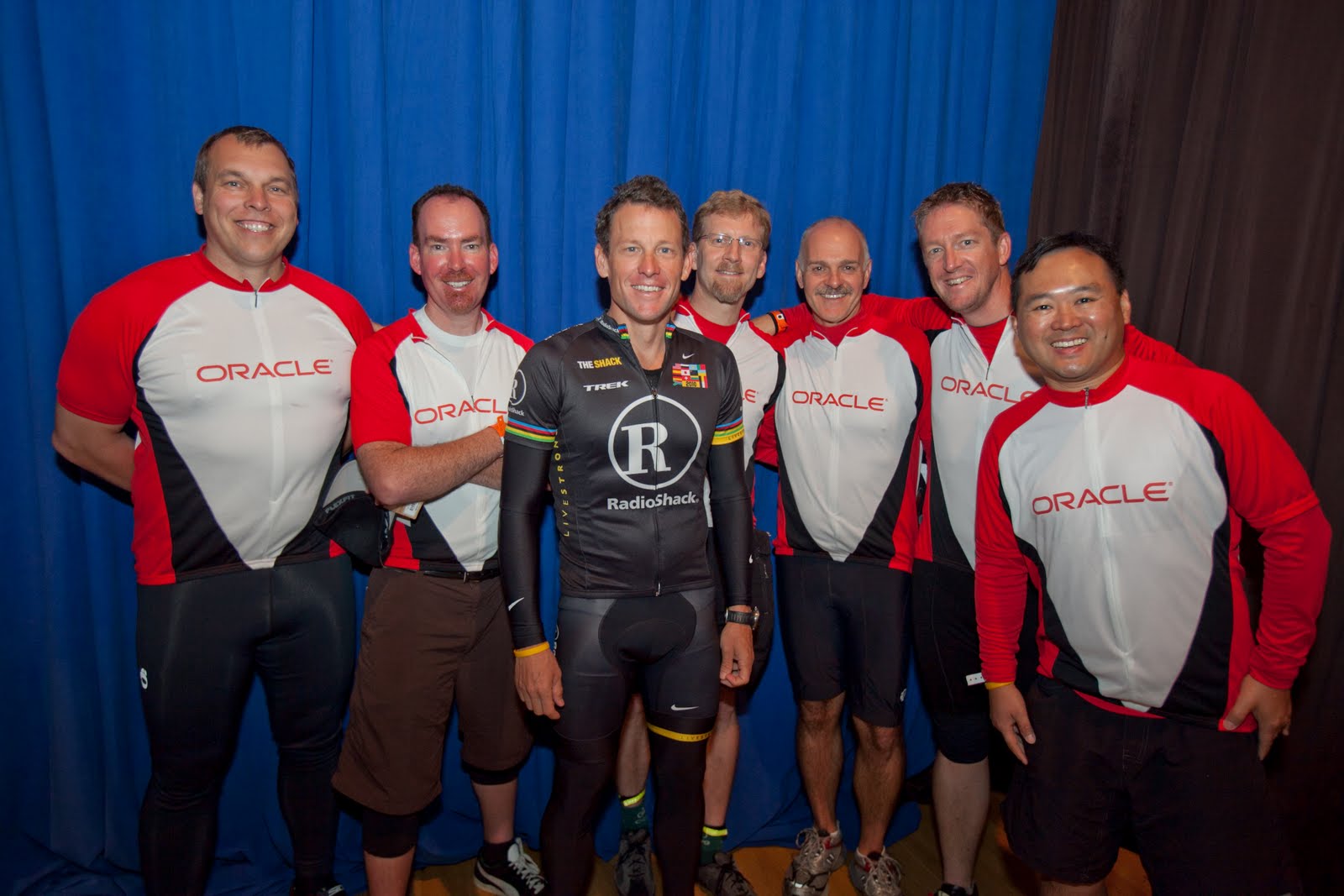
Oracle Customers Get To Ride With Armstrong


Seven-time Tour de France legend Lance Armstrong led a group of totally stoked Oracle customers on a predawn bicycle ride through the streets of San Francisco last week, capturing his first maillot rouge--a long-sleeved, red Oracle jersey. Oracle Executive Vice President John Fowler welcomed the crowd and introduced Armstrong, who asked the riders, after their 5 a.m. assembly, "Who was up the latest last night? How many of you were out all night? I'm steering clear of you for sure."

After a course overview and safety lecture from Oracle Senior Director and cycling team captain Brian Dayton, customers mounted loaned bikes (Trek 7200 Comfort Hybrids) and Armstrong began the 7-mile ride, leading the peloton of 100 or so along the Embarcadero, complete with SFPD motorcycle escort. Blinking headlights and taillights illuminated the darkness as the riders rolled under the Bay Bridge to Levi Plaza, and returned south toward AT&T Park. After the stage, cyclists enjoyed breakfast and Oracle Executive Vice President Chuck Rozwat introduced the Texas native, who agreed to pose for photographs and answer a few questions. Subjects ranged from surviving cancer, whether he'll race Ironman Triathlon (no comment), and the challenges he faced winning the Leadville Trail 100 Mountain Bike Race, a grueling hundred-mile race at elevations as high as 12,424 feet.

In response to a question concerning racing etiquette in the recent Tour, where winner Alberto Contador didn't stop to wait for Andy Schleck when his chain fell off, Armstrong described racing as quite political: "It's part chess, part NASCAR, part marathon, and part Tea Party."

Team Oracle Cycling (from left) Brian Dirking, Team Captain Brian Dayton, Radioshack's Lance Armstrong, Rich Schwerin, Mike Gagas, Roger Scott, Lawrence Leung.

Chris Lieto's More Than Sport for Ironman World Championship 2010

Monday, September 27, 2010

Cavendish says Worlds course is too difficult


Mark Cavendish (HTC-Columbia) has stated that the world championships circuit is more difficult than he had previously anticipated. The Manxman tested the course over the weekend and admitted that he may have to lower his expectations significantly ahead of next Sunday’s road race.

“The course is certainly too difficult for me,” Cavendish told RTBF. “I hadn’t seen the circuit myself before now.

“According to what people had been telling me beforehand the rainbow jersey was a possibility, but now that I’ve been able to check it out for myself, I’ll have to revise my ambitions.”

Cavendish had been bullish about his chances up until the weekend, telling the Sunday Independent, "I'm not going into it thinking 'I'm going to win this'... but there's a chance.”

The sprinter arrives in Australia after a fine Vuelta a España, where he won three stages and the points classification and, as his victory at the 2009 Milan-San Remo demonstrated, he is more than capable of contesting a sprint finish at the end of a 260km race.

Opinion on the nature of the Geelong course continues to be varied. While Cavendish’s sprint rivals Oscar Freire (Spain), Tyler Farrar (USA), Thor Hushovd (Norway) and AndrĂ© Greipel (Germany) will all be present and hoping for a bunch finish, Paolo Bettini did not name a recognized sprinter to his Italian squad.

Ivan Basso Wins Stage 15 of The 2010 Giro


Recovox will take a look back during the next few months at some of the more Epic rides and wins over the 2010 season. Here is the ride that won the 2010 Giro for Ivan Basso.


Besides making his comeback complete by winning the Giro for the second time Ivan Basso also launched his own shoe line with Lotto.

Eating practices of the best endurance athletes in the world


Owen Anderson, Ph.D.

It's strange, but true: The nutritional practices of the best endurance athletes in the world have not been carefully studied.

Those "best endurance athletes" are clearly the Kenyan runners. Attempting to verify this fact for you is probably unnecessary, but it can at least be noted that one study found that athletes from just one collection of Kenyans, the Kalenjin tribe, had won approximately 40 percent of all major international middle- and long-distance running competitions in the 10-year period from 1987 to 1997.

In addition, approximately half of all of the male athletes in the world who have ever run the 10K in less than 27 minutes hail from Kenya. When they're allowed to enter freely, Kenyan athletes dominate road races around the world.

And yet, until now the eating habits of the top-level Kenyan runners haven't been examined in a scientific way, even though the Kenyans' nutritional practices must assuredly represent a key reason for their running success. The person who argues that "If only the Kenyans would eat differently, they could run much faster," would be on flimsy ground. The Kenyans are doing things right when they sit down at the dinner table, or they wouldn't dominate international competitions.

But what is it exactly that they're doing? Are they Zone dieters, followers of the Perricone Promise, adherents of the Atkins Diet, or do they focus on the South Beach eating plan? Do they eat lots of "discredited" carbs or large ladles of lipids? From what foods do they get their seemingly limitless energy for running?

Study specifics

To answer these questions, Yannis Pitsiladis of the International Centre for East African Running Science in Glasgow, Scotland, along with Mike Boit (the Olympic bronze-medal winner from the 1972 Games), Vincent Onywera, and Festus Kiplamai from the Exercise and Sports Science Department at Kenyatta University in Nairobi and the Department of Foods, Nutrition and Dietetics at Egerton University in Njoro, Kenya, recently monitored everything that went into the mouths of 10 elite Kenyan runners over a seven-day period at a training camp near Kaptagat, Kenya.2

This group of Kenyan athletes was truly top-level, including several Olympic medalists and also first-place finishers from the Paris and Athens World Championships.

All 10 runners belonged to the Kalenjin tribe, with five from the Nandi sub-tribe, three from the Keiyo grouping, one Tugen individual, and a Sabaot. Two of the athletes specialized in 1,500-meter running, while the other eight were training for eight- and 12-K cross-country competitions.

The average age of the Kenyans was 21, and mean height was 1.75 meters (~5' 9"), with remarkably little variation in stature (the shortest individual was 1.70 meters, the tallest 1.80 meters, which meant that the smallest and greatest heights were just three percent away from the mean).

As you might expect, the Kenyans were lean, with body weight averaging ~58.6 kilograms (129 pounds) and body fat ranging from about six to 10 percent.

Click on the title link to read on....

Friday, September 24, 2010

Chris Lieto diary: Preparing for the Ironman World Championship


By Chris Lieto, special for USA TODAY

Editor's note: Triathlete Chris Lieto is documenting his preparations for the Oct. 9 Ford Ironman World Championship in an exclusive online diary for USA TODAY. This is his first entry:

Thursday, Sept. 23: Well, the Ford Ironman World Championship is here again. A couple weeks away and I am relaxing with the ocean breeze cooling me down after a hard ride. I love the Big Island of Hawaii. I have really grown to love this place. I have raced here over 10 times and have spent many more trips over here to train on the course. I have found that the best place for me to stay and get the job done is at the Hilton Waikoloa. I like being a little removed from downtown Kona (about 20 miles), it's more peaceful and relaxing. I can ride anywhere from here and cover the farthest half of the bike course or head to town and ride the first and last part. There's also great ocean swimming right here and running trails very close. Perfect place!

Coming here every year I have learned what I need to bring and how to approach this journey. I have added some things the last couple years as I get more serious in trying to win this race. Last year I was second and would like to move up a slot, so I have decided to add something I have not in the past to prepare the best I can. This year I am bringing a good friend of mine, Steve Gerace, who has helped in my preparation in training in Mammoth and at home. He came with me to Kona in February and is a huge asset. I am also bringing my personal massage therapist, acupuncturist and nutritional consultant the last 2 weeks before the race as well. This will help me stay loose and my preparation for this years' race should be right on.

We packed up the Trek Speed Concept and shipped it over a couple days early so we would not have to hassle with it on the plane. Airlines are charging sometimes over $200 to bring your bike each way. We also sent over a couple boxes with daily essentials: core workout equipment to keep the core workouts going with TRX, med ball, balance platforms, also massage tools like TP Therapy equipment so I can keep my muscles loose without always having to go to a massage therapist. We also brought extra pairs of my K-Swiss training running shoes and a couple pairs of race shoes … always good to have a backup pair. Being in this hot and humid environment makes it important to get the right nutrition and supplements into your body. Electrolytes are a must, along with training and race day nutrition. My sponsors PowerBar and Base Performance send over a supply to last me the whole trip, so it makes it easy. I do a lot training in these conditions to make sure I'm ready come race day. The easy stuff to pack is the clothes. You really only need a couple pairs of shorts, flip flops and a couple T's, all that fits in my carry-on! It's the rest of stuff that is difficult … huge bags, boxes, massage table, bikes, etc.

Flying before a race can be exhausting and take more out of you than you would think. That is one reason why I come over to the island three weeks before the race. When flying to a race I will try and upgrade to first class or at least move up to the section with more leg room. I have spent a lot of time and energy on training for this race so it is important to be comfortable, especially if I have to fly for five hours. I will drink lots of water and try and get up at least every hour and go for a little walk up and down the aisle. I will stretch a little in the seat as well as when getting up and walking around. My TP Therapy massage ball is key while sitting in the plane as I can massage areas that may get tight and keep my body loose. I will also travel wearing compression clothing to keep the circulation in my legs moving really well. By doing these simple things I get off the plane in Hawaii and always feel good and ready to go. When I settle in my room I will head out for an easy ride and/or swim just for the purpose to get my body moving and the blood flowing again. This really helps me get back on track and ready to attack the training that is needed the next morning.

I am looking forward to this years' Ironman World Championship and have only been here for a couple days! I'm feeling great, loving the weather and relaxing by the pool on my down time.

Aloha,
Chris

Tuesday, September 21, 2010

Lance Armstrong Visits San Francisco Hospital


San Francisco Mayor Gavin Newsom and Lance made a surprise visit yesterday to the San Francisco General Hospital’s Avon Comprehensive Breast Care Center. Together they toured the infusion center, where patients were receiving treatment, and a portion of the oncology center. They also met with hospital doctors to discuss the Hispanic/Latino cancer burden and the need for programs and resources that are tailored to address their needs.

“There is a great need for resources that improve the quality of life for Hispanic and Latino cancer survivors and San Francisco’s community groups and medical professionals are working to fill that need,” said Lance. “LIVESTRONG is proud to be a part of the effort to provide Hispanic families affected by cancer with customized tools and support they need to live life on their own terms.”

RBA - 2010 INTERBIKE PREVIEW


This coming week is the big week for the American cycling industry when we gather in Las Vegas for the annual Interbike trade show. And yeah, it's not open to the public and so yeah, we know it's a tad unfair to talk about Road Bike Action's own Bob Roll showing up at the RBA Booth at 10:00 am on Friday to sign autographs. In recognition of of the injustice, we promise to get a personally autographed poster from the former 7-Eleven rider and current Tour de France commentator to the person who...see contest info below.

George Hincapie At The BMC Booth

Every year the halls of Interbike are filled with cycling stars from today and yesteryear. Besides Bobke at the RBA booth and at the Headsweats booth (#1400), George Hincapie will be signing autographs at the BMC booth (#1883) on Thursday at 1:00.

Win A Personalized GiustaForza Torque Wrench
Cantitoe Road announces that they will be exhibiting at the 2010 Interbike International Trade Expo, taking place 22 September through 24 September in Las Vegas, Nevada. The Cantitoe Road booth #3631, will feature the top selling brands Effetto Mariposa and AXA.

During the show Cantitoe Road will gift a personalized Giustaforza Pro Torque Wrench to one eligible shop owner or employee. Stop by the Cantitoe Road booth #3631 to enter. The winner will be mailed a Giustaforza Pro wrench with their name or personalized message engraved. This giveaway kicks off Cantitoe Road’s fall engraving promotion (beginning at Interbike); purchase any Giustaforza Pro, Standard or Basic and for just $20/per wrench you can have your name or message laser etched on the best torque wrench in the bike biz!

Also at the show, meet the man behind the Giustaforza and Caffélatex products, Alberto De Gioaninni, founder and engineer of Effetto Mariposa. He will be showcasing his newest products, new Giustaforza wrenches and Caffélatex ZOT!, a sealant activator. For more info, turn down Canitoe Road.

'CROSS VEGAS IS WEDNESDAY & OPEN TO THE PUBLIC

Remember when Lance shocked the troops two years ago by making a surprise appearance 'Cross Vegas? Will the Tall Texan make a repeat performance this year?

CrossVegas organizer Brook Watts sounded like a Las Vegas odds maker as he described the field that he has managed to bring together for the September 22nd race. “The winners of the CrossVegas titles are going to come from the best field ever assembled in America. Whether you break it out by national champions attending where we’ve got 8 nations covered. Or if you look at the international rankings we’ve got 3 of the top 10 riders in both the Elite Men and Elite Women categories. If you look at it from another level you’ve got the returning champions from the previous editions of CrossVegas. And then to really top it off you’ve got a dozen “wild card” contenders and any one of those riders could draw an ace on race day!”

Talk about a great problem to have as a race organizer. For the first time in America a gathering of national champions from 8 nations that includes:

Elite Men
Tim Johnson (Cannondale – Cyclocrossworld.com) – USA
Geoff Kabush (Team Maxxis-Rocky Mountain) – Canada
Marco Fontana (Cannondale Factory Racing) – Italy
Francis Mouray (Francaise des Jeux) – France
Geert Wellens (Champion System) – Belgium (Elite Category)
Joachim Parbo (KCH Leopard Cycles) – Denmark
Zoltan Tisza (Tecnofilm Bentonexpressz 2000) – Hungary

Elite Women
Katie Compton (Planet Bike) – USA
Katerina Nash (Team LUNA Chix) - Czech Republic

In addition to the national champions the Elite Men’s field will be stacked with riders from the top 20 U.C.I. ranking. Riders like 5th ranked Gerben De Knegt of Holland (Rabobank Continental Team), Francis Mouray (Francaise des Jeux) at 7th, Christian Heule of Switzerland (Rendementhypo Cycling Team) ranked 9th and American Jonathan Page (Planet Bike) ranked 18th.

The Elite Women’s field will include 5th place Katie Compton of the U.S. (Planet Bike), 7th place Katerina Nash of Czech Republic (Team LUNA Chix) and 16th place Amy Dombroski of the U.S. (Team LUNA Chix).

Returning are 2009 CrossVegas champions Jamey Driscoll of the U.S. (Cannondale – Cyclocrossworld.com) and Katie Compton (Planet Bike) who also won in 2008. Ryan Trebon (KONA), winner of CrossVegas 2007 and 2008 will be returning. Trebon and Compton are CrossVegas’ only 2-time winners.

Stressing that this preliminary list was sure to grow as the countdown to September 22nd proceeds Watts said “Don’t under estimate the other great riders who will be coming to CrossVegas” and began listing Americans Jeremy Powers (Cannondale – Cyclocrossworld.com), Adam Craig (Rabobank-Giant). Georgia Gould (Team LUNA Chix), and Meredith Miller (Cal Giant-Specialized). Tim Van Nuffel of Belgium (Vangoethem-Prorace), Martin Grujan of Switzerland (Cannondale Factory Racing), CrossVegas 2009 Silver medalist Chris Jones (Rapha-FOCUS) and Davide Frattini from Italy (HUDZ- Subaru). “I’ve probably missed a half a dozen top guys and gals that are capable of turning CrossVegas upside down.”

Watts concluded by saying, “CrossVegas is fortunate to have an abundance of talented riders who want to start their season in front of the largest crowd in American cross racing. The real winners are sure to be the spectators.” For more info, head to Cross Vegas

Lazer Party Kicks Off Interbike
Lazer Sport NV will be hosting the Lazer Oasiz, a party to welcome the start of the 2010 Interbike trade show, on Tuesday September 21st. Next year Interbike moves to Anaheim California so we bid farewell to Las Vegas in style!

Taking place at the North Beach Club outside at the Hard Rock Hotel and Casino, the Lazer Oasiz will host dealers from around the United States, representatives from major industry media outlets and professional athletes. Including:
Brian Lopes - 4 time world champion, 6 time World Cup champion, 9 time national champion
Tim Johnson - US national cyclocross champion
Jonathan Page - 6 time national cyclocross champion, 2007 world championship silver medal
Catharine Pendrel - 2010 MTB World Cup champion
Jeremy Powers - 1st overall 2009 USA cyclocross ranking
Jamey Driscoll - Winner Cross Vegas 2009

Komosa is being specially imported from Belgium to serve as DJ for the event.

To celebrate the event, and to officially launch the new product for 2011, a special edition Lazer Oasiz helmet will be on display and available for dealers to order at the party.

VIP entry is set for 7pm. General admission to Interbike attendees is set for 9pm (Interbike badges required for entry).
Facebook: bit.ly/LazerOasiz
Twitter: twitter.com/LazerOasiz

OTHER NOTABLES TO CHECK OUT:
* Ace wheel designer Paul Lew will be at the Reynolds booth at 10:00 daily.
* German beer at the Focus booth daily.
* Frankie Andreau at Mercury Booth #4871 from 2-3:00 on Thursday
* Alessandro Petacchi will be at the Wilier booth #2219 from 2-3:00 on Thursday.
* Ryder Hesjdahl singing posters at LeMond Fitness booth #105 on Wednesday, 11-12:00.
* Garmin Transitions team at the Vittoria booth #337 on Wednesday, 3:30-4:30.

WestCoast GoldSprints and OpenSprints Showcase Roller Racing
WestCoast GoldSprints, the premiere event organizer dedicated to roller racing, has announced it will host the 2010 GoldSprints World Championships this year in Las Vegas, coinciding with Interbike and in partnership with OpenSprints, the electronic timing solutions provider for roller racing, Kreitler Rollers and Marin Bikes.

Taking place on September 23, 2010 at 8pm at Las Palmas Mexican Grill (953 East Sahara Avenue) in Last Vegas, the 2010 GoldSprints World Championships will offer racers in both men's and women's divisions $10,000 in cash and prizes. GoldSprints roller racing pits recreational riders, professional cyclists and industry fans against each other as they aim to complete the fastest 500 and 1,000-meter sprints on track bikes affixed to rollers.

The 2010 GoldSprint World Championships will see the best GoldSprints racers from around the world converge to battle for supremacy. Qualifying rounds, hosted by WestCoast GoldSprints as well as OpenSprints organizers on local levels, start August 1st across cities worldwide and culminate at the 2010 World Championships in Las Vegas. Wild Card entries will be open to Interbike tradeshow attendees and the general public, with wild card qualifying rounds taking place at Kreitler Rollers' Interbike booth #4381 on September 22 and 23.

"Last year's GoldSprints event at Interbike was a screaming success because attendees were so stoked on the Kreitler Cup," said Murphy Mack, who founded WestCoast GoldSprints in 2006. " We're looking forward to the no-holds barred, sweat-inducing, crowd-rousing battle of the first ever GoldSprints World Championships. Be sure to follow us on Twitter @WCGoldSprints to keep up to date on developments prior to the big showdown."

What: 2010 GoldSprints World Championships
When: Thursday September 23rd, 2010
Where: Las Palmas Mexican Grill, 953 East Sahara Avenue, Las Vegas, NV
Time: 8pm - 2am PDT; doors open at 7:30pm PDT
Sponsors: OpenSprints, Kreitler Rollers and
Marin Bikes

$10,000 IN CASH AND PRIZES!
Entry fee: $20, contributes to the cash purse
www.gswc2010.com

Thursday, September 9, 2010

Basso looks to Sagan, Oss for Canada success


Giro d’Italia winner Ivan Basso (Liquigas-Doimo) is prepared to work for his teammates Peter Sagan and Daniel Oss at this week’s Canadian ProTour races. The two one-day races are expected to be held in wet conditions in Quebec City on Friday and Montreal on Sunday.

“It is a pleasure for me to be in Canada,” Basso said. “I think it is really nice for me to do these two important races to finish off my season, but after the Giro d’Italia and the Tour de France my form at the moment is not 100 percent.

“I feel good but it is normal after racing the Giro and Tour; it is hard to arrive to the end of the season in really good shape,” he added. “Our plan is for our good riders Sagan and Oss, who are both feeling very good. So we will try our best with them.”

The Grand Prix Cycliste de Quebec City will challenge the peloton to 15 laps of a hilly and highly technical 12.6 kms circuit, which begins on the Rue Saint Louis, descends through the scenic Parc des Champs de Bataille and winds its way down to the shores of the Saint Lawrence River. The men will weave their way up the steep inclines of the historical centre before passing through doors to the city - Porte St Jean and Porte St Louis - and head back up to the start-finish line on the Rue Saint Louis.

“I think the circuits will be more difficult than a point-to-point race because you always come back to the climb and it isn’t easy to catch a break if it is a big one,” Basso said. “The strategy of the team; it will be important never to use the whole team to bring back one breakaway. We have to be in the break, all the time in the front and make sure to finish with three guys in good shape, with a lot of energy, to be ready for the last hour of the race.”

According to Basso, the circuit-style events are well-suited to the young Sagan, who won two stages of the Tour of California, two in Paris-Nice and a stage at the Tour of Romandie. Oss is an all-rounder who this year place in the top 10 at the Giro della Provincia di Reggio Calabria, Tour of Oman and Gent-Wevelgem.

Basso won his second Giro d’Italia this year in difficult conditions that made for perhaps one of the most epic editions in the event’s history. Basso won stage 15 atop Mount Zoncolan and he took over the pink leader’s jersey following stage 19.

“We have to keep the morale high and not think about the weather,” said Basso regarding the weekend’s forecast. “I did 13 days under the rain at the Giro d’Italia this year so I have good training.”

Race organisers of the Grand Prix Cycliste de Quebec City and the Grand Prix Cycliste de Montreal secured a five-year ProTour license in part because of the International Cycling Union’s (UCI) effort to globalize professional cycling. They are the first ProTour event in North America but next year there is a strong possibility that the Giro d’Italia could start in Washington DC, USA.

“It is very nice and important to race all over the world,” Basso said. “I have a good impression of this organisation already with a fantastic hotel [Fairmont Le Chateau Frontenac]. We arrived three days before so there is no jet-lag. It is a lot of work for the organisation but we appreciate their efforts.”

Wednesday, September 8, 2010

Chris McCormack: Pre-Race Energy

It takes all the right ingredients to be a successful professional triathlete. Chris McCormack has the ideal mix -- great ambassador for the sport, a terrific accent, and one of the world's best triathletes. But even Chris experiences pre-race jitters and gets a tad nervous in the hours before a race. Take a look at how Chris channels his energy so that he's ready to rock when the starting gun goes off.

Friday, September 3, 2010

SA Triathlon Plus sits down with"T" Bozzone


By Glen Gore – Editor, Triathlon Plus South Africa

Terenzo Bozzone - once south african, now kiwi has burnt up the 70.3 circuit this season, which at last count stood at four wins and five second places out of 9 races. He won the World title back in 2008 and has recently been carving up a storm in the pro ranks. Another simple reason we’re featuring this guy is that he’s a born and bred South African, and originally hails from Johannesburg.

We had Men’s Olympic Triathlon Champion and current world number one on the ITU circuit, Jan Frodeno on our cover in July. He also hails from South Africa and is based in Cape Town. Our South African- Kiwi citizen Terenzo Bozzone , who, based on ranking points and victories, is easily the current world number one over a 1.9km swim, 90km bike and 21km run.

I was fortunate enough to train with Terenzo and his training partner, ace IM specialist Kieron Doe whilst I lived in New Zealand. They lived just down the road from me and we shared quite a few six hour rides in the Waitakere Mountain Ranges, where they do most of their base training, before heading off to conquer the world. I chatted to him about life and triathlon and this is what he had to tell us.

I have heard you left South Africa when you were about eight or nine years old - I know it’s not a major part of your life, but it’s good to know that a world champion originally comes from these shores!

I was born in Johannesburg in 1985 and lived there until I was 10 years old. I went to Emmerentia Primary and represented Gauteng in national swimming. I also represented South Africa at the Karate World Champs in the early 1990’s.

Tell us how you found your passion for Triathlons.

When I was 13 and living in New Zealand I was wakeboarding behind a boat, tried to do a flip and landed on my head, bursting an ear drum. I had several operations on my ear and was forced out of the water for a few months. That is when I was introduced to Duathlons and I was hooked!

Is your core focus on the long-distance races? No more Olympics?

The longer stuff is more appealing to me at the moment. I am really enjoying the lifestyle and the people I meet while training and racing for the non-drafting races. Ironman is where my focus is heading, but the half distance races work really well with my training in the middle part of the year, along with the occasional non-drafting Olympic distance race.

At the moment, you’re kicking major butt almost weekly in half Ironman events. What’s your secret to such consistency?

Shhhh! It’s a secret! I really like the distance and I think the training for the Ironman stuff has given me a great base that allows me to recover quicker and race more consistently. The thing with the Half Ironman’s is that if you race your race, you will determine the outcome. To a large extent it doesn’t matter what your opponents are doing.

New Zealand is a small country with a relatively small triathlon community. How is it that they produce such good triathletes? I lived amongst you for a while but I’m still trying to figure it out!

If you had lived there long enough we would have shown you the special watering hole…I guess the small community makes us all try harder to stand out amongst the others. Hamish, Bevan, Kris and Brownie have all done great things recently, but the history in the country goes back way further than us. The terrain is perfect for all types of training and we have people who have pioneered the principles of training - like Arthur Lydiard.

Ironman New Zealand – when are you going to knock Cameron off that top spot? It’s close, right?

Good old Brownie. I just wish he could pull out those performances in Kona. He really does step up his game down in Taupo on the IMNZ course. I think I have learnt a lot the past couple years, and my limits have increased substantially. I can hopefully make the race a little closer next year and who knows, if things go my way I may be able to prevent Cameron’s goal of winning 10 in a row.

The Waitakere Mountain Range – it’s a fantastic place to ride and train, and I know you rate it highly – tell us a bit about it.

The good old Waitakeres! The place where legends are made - Peter Snell and all those guys did their long runs in the ranges, and I have often spent weeks on end riding out there, accumulating thousands of meters of climbing. The scenery is great and the roads are reasonably quiet. I just hate it when they do road works out there - they put a bit of tar down, then sprinkle stones on top of it and hope they stick. It takes a few weeks for the loose stones to get off the road.

Is there anything we don’t know about Terenzo Bozzone the triathlete? Something apart from sport, for instance, I know you like to party?

Party – who me? I like my sleep too much! I love living life on the edge. When I have a flight I make sure I don’t arrive at the airport one minute earlier than I have to - this goes for transition on race mornings too. I like every aspect of my life to be competitive, but don’t like it when I lose or don’t achieve my goals - especially the goal of not having to pay for my bike at airports in America. I also enjoy posting tweets while I race. You can find me on: "www.twitter.com/terenzo1.

I am an awesome chef, like “Jamie Oliver” awesome… but it only happens every leap year though.

IN CONCLUSION

We certainly have the talent in this country. We need to catch them early on and develop them like all these other countries do - and then we could also have future World and Olympic Triathlon Champions living and training in South Africa, competing under our banner...something our younger triathletes can take heed of, and hopefully aspire to.

- Article Courtesy of Glen Gore – Editor, Triathlon Plus South Africa.